
Criminal Justice
✅ What to Expect in This Course
📢 New in 2026–2027: Program‑specific course content will be weighted as Honors‑level coursework. See Program Coursework below for more details.
🧠 Learning & Coursework
This one‑year Criminal Justice program introduces students to the structure and purpose of the criminal justice system. Coursework focuses on foundational knowledge related to law enforcement, courts, and corrections while emphasizing academic rigor, discussion, and written work. Students should expect coursework that requires careful reading, analysis, and consistent engagement with course material.
🧩 Exposure to Sensitive & Real‑World Criminal Justice Topics
Due to the nature of the criminal justice field, course discussions and instructional materials may include mature and serious subject matter. Topics may involve crimes and situations that result in incarceration, such as violent offenses, sexual crimes, abuse, self‑harm, and loss of life. These topics are addressed for educational purposes in a professional, age‑appropriate manner.
Students are expected to engage respectfully, thoughtfully, and maturely during discussions. This course is designed for students who are prepared to examine real‑world issues that criminal justice professionals encounter and must be handled with seriousness and discretion.
🏛️ Field‑Based & Career‑Aligned Experiences
This course includes activities designed to reflect expectations in criminal justice and public safety training environments. Students participate in physical training (PT) activities that emphasize fitness, discipline, and personal accountability. Students will also visit criminal justice institutions such as state police academies, jails, and other law‑enforcement settings to gain exposure to professional environments.
🏅 Student Leadership & Certifications
Students are expected to participate in SkillsUSA, a national career and technical student organization that emphasizes leadership, teamwork, professionalism, and technical skill development within the skilled trades.
In addition to earning course credit, students will work toward industry‑recognized credentials, including:
NOCTI certification
911 Dispatch Certification
Workplace Readiness Skills (WRS) certification
These credentials allow students to graduate with documented skills, certifications, and career preparation—not just a grade.
👔 Professional Conduct & Daily Expectations
This program operates with clearly defined Crimimal Justice workplace expectations. Students are expected to:
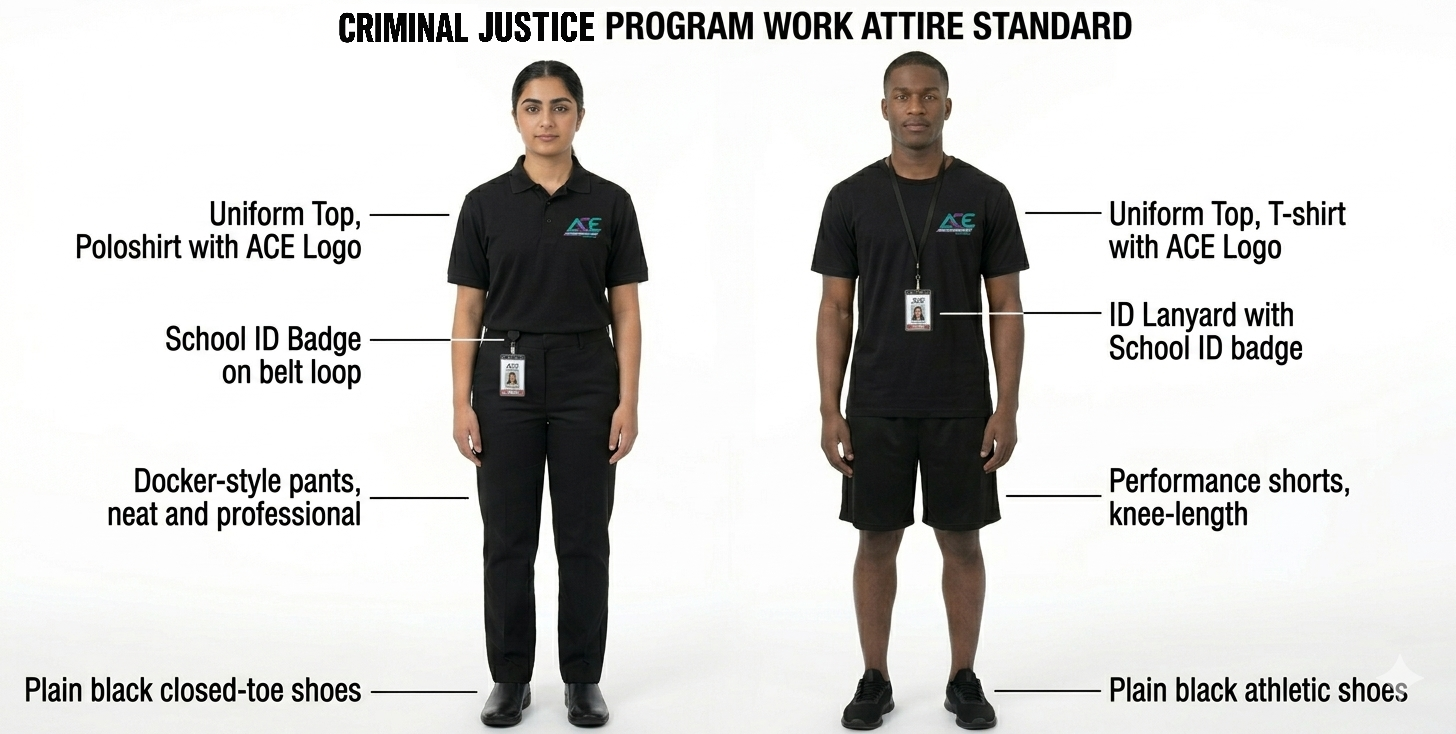
Purchase specific work attire for daily wear when attending ACE classes and events
During physical training and selected instructional activities, students will dress out in shorts or appropriate physical training attire and may be required to wear safety patrol reflective vests when participating in law‑enforcement or public‑safety simulations.
Display a visible ID badge at all times
Demonstrate professional behavior, punctuality, accountability, and respectful communication
Criminal Justice is a field built on responsibility and public trust. Students are expected to follow attire guidelines and conduct expectations consistently, as these standards mirror those required in postsecondary training and public‑service careers.
⬇️ Work attire sample images appear in the image carousel below
Slider is playing
Program Coursework
1 year (3 HS credits) – Advanced Career Education (ACE) Center at Hermitage (Additional Location: ACE Highland Springs)
This program is designed to be completed in one year during the 11th or 12th grades.
Criminal Justice I - 1 credit (Honors): Students are introduced to law, public safety, corrections, and security practices. Students examine contemporary issues in the criminal justice system and explore crime scene investigation, criminal investigation, court procedures, policing, and juvenile justice. This course provides a foundation for careers as lawyers, crime scene investigators, emergency communications professionals, and law enforcement and corrections officers.
Criminal Justice II - 2 credits (Honors): Students apply knowledge learned in Criminal Justice I through practical scenarios involving crime scene investigation, criminal investigation, and crisis intervention. Students explore trends in correctional standards and in identifying and preventing terror threats. This course prepares students for careers as lawyers, crime scene investigators, emergency communications professionals, and law enforcement and corrections officers.
🏫 Dual Enrollment Notes
(AVAILABLE) Six transferable college credits through our partnership with Reynolds Community College may be offered.
Offerings are tentative and confirmed each semester.
Instructor