Emergency Medical Technician
✅ What to Expect in This Course
📢 New in 2026–2027: Program‑specific course content will be weighted as Honors‑level coursework. See Program Coursework below for more details.
🔍 Prerequisites: Emergency Medical Technician (EMT) Program
Must be a Junior or Senior
Must be at least 16 years old
Biology: Grade “C” or better
Algebra I: Grade “C” or better
🧠 Learning & Coursework
This EMT program prepares students for the academic and practical demands of emergency medical services. Coursework focuses on medical terminology, patient assessment, emergency care procedures, and decision‑making in pre‑hospital settings. Students should expect a fast‑paced course that requires strong study habits, attention to detail, and consistent engagement with material that builds toward real‑world application.
💪 Physical Demands & Hands‑On Expectations
EMT training is physically demanding. Students are active daily and should expect standing for extended periods, lifting and moving equipment, kneeling, bending, and working in confined spaces. Hands‑on instruction includes patient movement, simulated emergency responses, and skills practice that require physical stamina, coordination, and adherence to safety procedures.
🧠 Exposure to Medical Emergencies & Stressful Scenarios
Due to the nature of emergency medical services, students will be exposed to real medical emergencies through instructional content, simulations, and 10 required patient contacts through EMS ride‑along and emergency room clinicals . These experiences may involve serious illness, traumatic injury, medical crises, and life‑threatening situations encountered by emergency responders.
Content is presented for educational purposes in a professional setting. Students are expected to engage maturely, follow all guidelines, and handle observations and discussions with discretion and respect, reflecting the responsibilities of emergency medical professionals.
🏥 Career‑Aligned & Field‑Based Learning Expectations
This course is designed to reflect the structure and expectations of emergency medical training environments. Active members of Henrico Fire and EMS serve as guest instructors for multiple weeks, working directly with students during instruction.
🏅 Student Leadership & Certifications
Students are expected to participate in HOSA – Future Health Professionals, a national student organization focused on leadership development, teamwork, and healthcare career readiness.In addition to earning course credit, students are eligible to work toward industry‑recognized credentials, including:
National Registry EMT or EMR
Certifications for IS-100, IS-200, IS-700, IS-800, ARW-160 (terrorism for EMS professionals), HAZMAT Awareness, and Mass Casualty 1
These credentials allow students to graduate with documented skills, certifications, and career preparation—not just a grade.
👔 Professional Conduct, Attire & Daily Expectations
This program operates with expectations aligned to emergency medical service standards. Students are expected to:
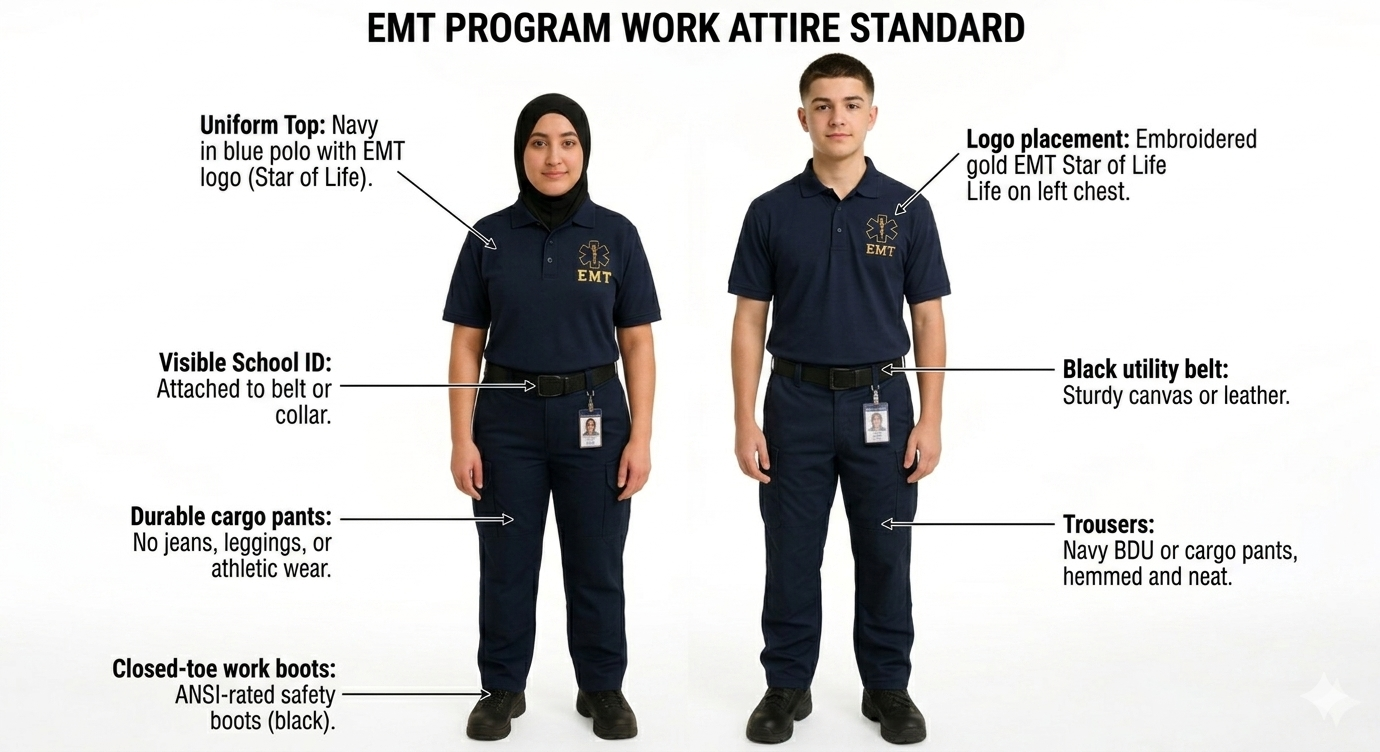
Purchase specific work attire for daily wear when attending ACE classes and events
Display a visible ID badge at all times
Demonstrate professional behavior, punctuality, accountability, and respectful communication
⬇️ Work attire sample images appear in the image carousel below
Slider is playing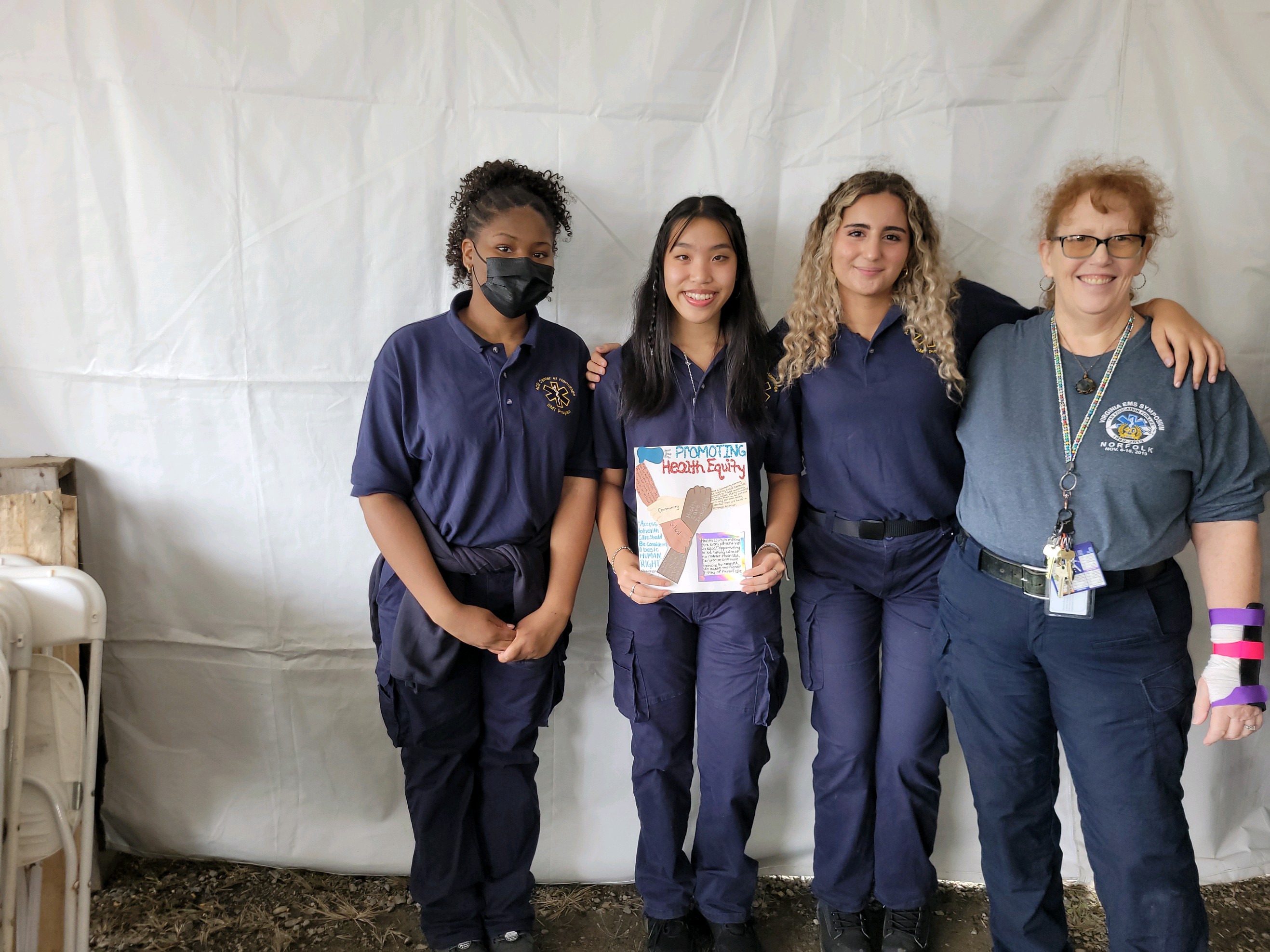
Program Coursework
1 year (3 HS credits) – Advanced Career Education (ACE) Center at Hermitage
This program is designed to be completed in one year during the 11th or 12th grade.
Emergency Medical Technician I - 1 credit (Honors): The tasks for this course represent the National Emergency Medical Services Educational Standards. Students explore and apply the fundamentals of emergency medical services, anatomy, physiology, and medical terminology. They demonstrate skills in assessing and managing patient care, including assessing the scene and understanding shock, resuscitation, and trauma. Successful completion of this course and instructor endorsement qualifies students to enroll in EMT II to complete the program sequence. Students must complete a minimum of 85% of the didactic and lab aspects of the course, per 12VAC5-31-1501 in the Virginia Administrative Code. Successful completion of all course requirements and instructor endorsement may lead to eligibility to take the National Registry of Emergency Medical Technicians cognitive exam. Students must meet the requirements of the functional position description for the basic life-support provider (refer to EMS.TR.14B and 12VAC5-31-1501). Contextual instruction and student participation in co-curricular career and technical student organization activities will develop leadership, interpersonal skills, and career skills. High-quality work-based learning will provide experiential learning opportunities related to students' career goals and interests, integrated with instruction and performed in partnership with local businesses and organizations.
Emergency Medical Technician II - 1 credit (Honors): This course builds on the knowledge acquired in EMT I. Students will continue to develop their skills in emergency medical services, focusing on advanced topics such as exercise physiology, biomechanics, exercise program design, and injury prevention, assessment, treatment, and management. Students will assess fitness, measure body composition, and design exercise programs. Students prepare for a career in sports medicine, including completing an internship, practicing interview skills, and building a resume.
Emergency Medical Technician III - 1 credit (Honors): This course is intended for students who have completed Emergency Medical Technician (EMT) I and II, obtained instructor approval, and who may have obtained EMT certification from the Virginia Office of Emergency Medical Services (OEMS). Students will strengthen the skills mastered in the basic courses as they acquire skills to assist advanced life support (ALS) providers, build on the foundations of emergency medical services (EMS) education, and meet education requirements for certification or recertification. Students also learn to coordinate with other public health and safety services, such as fire control, law enforcement, and emergency management. The course includes mentored as well as instructional experiences. Students must complete a minimum of 85 percent of the didactic and lab aspects of the course.
🏫 Dual Enrollment Notes
(Mandatory) Nine transferable college credits through our partnership with Reynolds Community College are mandatory.
Instructor