Game Design and Web Technologies
✅ What to Expect in This Course
📢 New in 2026–2027: Program‑specific course content will be weighted as Honors‑level coursework. See Program Coursework below for more details.
🔍 Prerequisites: Game Design & Web Technologies
Must be a Junior
🧠 Learning & Coursework
This program provides comprehensive training in game design and web technologies through a combination of classroom instruction and applied technical work. Coursework focuses on programming fundamentals, game development concepts, web design, and problem‑solving skills aligned with industry expectations. Students should expect a structured, academically rigorous course that requires sustained focus and independent practice.
💻 Hands‑On Development & Technical Workload
Game Design and Web Technologies is a hands‑on, production‑based program. Students regularly design, build, test, and revise projects using industry‑standard tools and technologies. Projects require careful planning, debugging, iteration, and meeting deadlines. Students should be prepared to spend significant time working through technical challenges and refining their work based on feedback.
🧠 Problem‑Solving, Collaboration, & Revision Expectations
Instruction emphasizes logical thinking, attention to detail, and persistence. Students are expected to troubleshoot errors, revise code and designs, and collaborate professionally during group or team‑based work. This process mirrors real‑world development environments where iteration, feedback, and continuous improvement are essential.
🏅 Student Leadership & Certifications
Students are expected to participate in SkillsUSA, a national career and technical student organization that emphasizes leadership, teamwork, professionalism, and technical skill development within the skilled trades.
Students who complete the program are eligible to earn industry‑recognized certifications, including:
CIW Site Development
Unity Certified Programmer
Agile/SCRUM PSM1
👔 Professional Conduct & Daily Expectations
This program operates with expectations aligned to professional food‑service environments. Students are expected to:
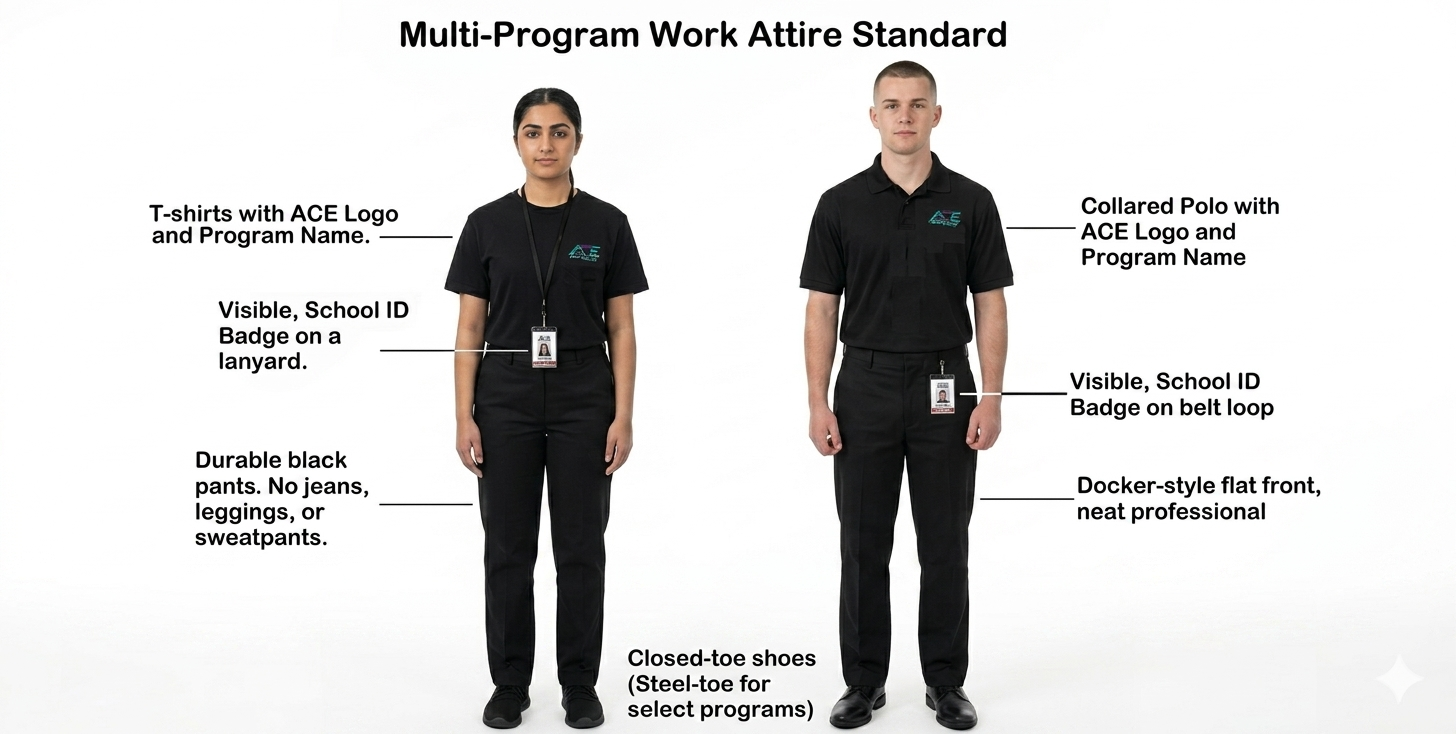
Purchase specific work attire for daily wear when attending ACE classes and events
Display a visible ID badge at all times
Follow all kitchen dress, sanitation, and safety requirements
Demonstrate professional behavior, punctuality, accountability, and respectful communication
Game design and web development require focus, problem‑solving, and discipline. Students are expected to meet these standards consistently, as project quality depends on individual effort and reliability.
⬇️ Work attire sample images appear in the image carousel below
Program Coursework
2 years (6 HS credits) – Advanced Career Education (ACE) Center at Hermitage
This program is designed to be completed in two years during the 11th and 12th grades.
Year 1 ( Junior Year )
Design, Multimedia, and Web Technologies 1 credit (Honors): Students apply creativity and technology to create visual design, multimedia projects, and web projects, using industry-standard software. Work-based learning experiences allow students to apply layout and design techniques in real-world situations. Students create portfolios that include a résumé, certifications earned, and a variety of projects produced in the course.
Design, Multimedia, and Web Technologies, Advanced 1 credit (Honors): In this course, students acquire advanced skills in design, multimedia, and web development by applying project management principles to create professional quality digital media projects. Work-based learning experiences allow students to apply layout and design techniques in real-world situations. Students create portfolios that include a résumé, certifications earned, and a variety of print, multimedia, and website projects produced in the course.
Programming 1 credit (Honors): Students will develop critical thinking and problem-solving skills by writing programs and exploring programming concepts, using algorithmic procedures, implementing programming procedures in one or more languages, and mastering programming fundamentals. Students will also develop interactive multimedia applications, including apps or games. Concepts in this course shed light on a wide range of career opportunities in the tech industry as students will learn valuable computational thinking skills that help them understand the modern digital world.
Year 2 ( Senior Year)
Game Design and Web Development 1 credit (Honors): The game design industry is the fastest revenue growing entertainment medium, and has created many new job disciplines. In this project-based course, students will create innovative games through the application of graphic design, animation, audio, and writing skills. Students will work in teams while developing problem-solving, critical thinking, and effective communication skills. They will analyze, design, prototype, and critique interactive games within a project management environment. Career opportunities across multiple industries, including the entertainment and educational arenas, will be explored.
Game Design and Development, Advanced 1 credit (Honors): Students will work collaboratively in teams to refine their game design skills as they apply graphic design, animation, audio and writing skills to create innovative games for education and entertainment. This project-based course enhances problem solving, project management, and communication skills through the analysis, design, construction, and critique of interactive games. Students will learn about career opportunities in game design and development and investigate the training and certification requirements.
Programming, Advanced 1 credit (Honors): This course is designed for students who have a solid foundation in programming and are ready to deepen their understanding of related concepts and practices. Students will write programs of increasing complexity to potentially solve real-world problems of personal interest and professional relevance. The course focuses on mastering advanced programming techniques, object-oriented programming (OOP), algorithm optimization, data structures, and software development methodologies. Students will explore real-world applications by working on collaborative projects, coding challenges, and hands-on labs. By the end of the course, students will have developed the skills necessary to design and implement efficient, scalable software solutions and will be prepared for further studies in the high-demand fields of technology.
🏫 Dual Enrollment Notes
(OPTIONAL) Transferable college credits through our partnership with ECPI may be offered.
Offerings are tentative and confirmed each semester.
Instructor